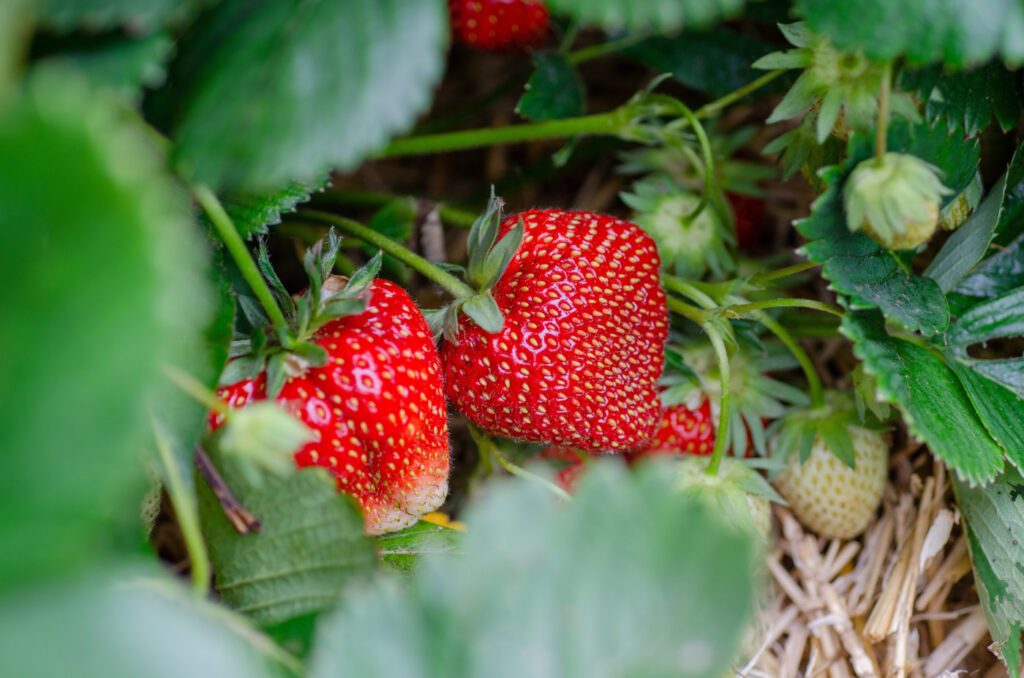
Strawberries:
Fresh plants (green plants)
In spring: From the start of the growing season: 4 l/ha with 400–1,000 l of water.
From pre-flowering: 2–3 l/ha with 400–1,000 l of water, repeat 2–3 times until fruit coloring.
Late summer: 8–10 days after planting: 12–15 l/ha with 1,000 l of water.
OR: Dip roots, rhizomes, and crowns for 1/4 hour in a 0.5% solution.
In autumn: Mid-October: 12–15 l/ha with 1,000 l of water.
Strawberries:
Frigo plants
In spring: 6–10 days after planting: 6 l/ha with 1,000 l of water.
OR: Dip roots, rhizomes, and crowns for 1/4 hour in a 0.5% solution.
Foliar treatment as required: 6 l/ha, repeat 1–2 times.
Fresh and frigo plants can also be fertigated. For this purpose, 6–10 l/ha of VITTAFOS are applied weekly from planting until fruit coloring.
Grapes:
Pre-flowering: 2–3 applications of 3–4 l/ha each at intervals of 8–14 days.
Post-flowering: 2–3 applications of 3–4 l/ha each at intervals of 8–14 days.
Pome fruit:
2 applications of 2.5–3 l/ha from petal fall until fruit coloring.
Post-harvest: 1–2 applications of 3 l/ha of VITTAFOS.
Specifically for pears: 2–3 applications of 2–3 l/ha each, as long as active foliage is still present.
Hops:
2 applications of 2.5 l/ha with 1,000 l of water, at a 2-week interval after spring budbreak.
During the crop cycle: Apply a 0.2%–0.25% solution in 1,000–4,000 l of water, depending on growth stage.
Cucumbers:
Open field: 4 applications at intervals of 8–10 days, 2 l/ha each.
Under glass: 2 to 3 times per week using a 0.2%–0.25% solution.
Chinese cabbage:
After planting: 2 times at a 7-day interval, 2 l/ha each.
Chicory:
Drip irrigation using a 0.03% solution.
Cauliflower:
3 weeks after planting: 2 times 3 l/ha at a 7-day interval.
Parsley:
Open field: 3 l/ha per week (2–3 treatments per cut).
Via drenching: 2 l/m² of nutrient solution with 0.2%–0.25% VITTAFOS.
Leek:
Apply 3 l/ha of VITTAFOS as required.
Chives:
At intervals of 8–10 days: 2 applications of 2.5 l/ha after each cut.
Head lettuce / Arugula, etc.:
Drench with a 0.2% solution before transplanting.
2 weeks after planting: 2–3 l/ha at a 7-day interval with a minimum of 600 liters of water.
Tomatoes:
3 l/ha multiple times as required until fruit coloring.
Onions:
2.5 l/ha, 2–3 times at intervals of 8–10 days.
Spinach:
2 l/ha, 2–3 times as required.